
Rethinking How We Train Scientists for Today’s Careers
By Jelena Patrnogić
When I think about what it takes to train as a scientist today, it is more than learning facts from textbooks or mastering a particular lab technique. It’s about the full set of skills and habits that let us do rigorous and creative science: asking good questions, designing solid experiments, analyzing data responsibly, communicating clearly, working collaboratively, and bouncing back when things fail. Today’s scientific workforce is incredibly diverse, with PhD-trained scientists working in academia, industry, and non-profits, among many other settings, so this broader skill set matters regardless of which path someone takes.
Over the past several years, I’ve been working with colleagues in the Harvard Medical School Research Rigor, Reproducibility and Responsibility (R3) initiative, focusing on graduate and postdoctoral training. In our conversations, we kept circling back to the same questions. If we care about rigor, reproducibility, and responsibility in research, how do we build those values into training in a concrete way? What should the “full picture” of scientific development look like, and how would we know if we were getting it right?
Those questions pushed us to rethink what high quality scientific training should look like and how we might innovate to meet those expectations. That work is described in our recent paper.
We used our largest life science PhD program, Biological and Biomedical Sciences (BBS), as a place to try out these ideas. We started by asking whether we could write down, in a clear structure, the skills scientists are expected to develop during training so that programs, mentors, and trainees could all use it to guide day-to-day training.
We gathered existing national recommendations and combined them with experiences from our own community. Informed by conversations with faculty, trainees, and education leaders, we identified 56 key competencies, grouped into 13 core areas, and organized them into a shared competency framework that makes expectations more visible and easier to act on. We designed the framework to be modular, so programs can emphasize or add competencies that fit their particular context. Importantly, the 13 core areas (see image) are purposefully arranged in a circular fashion, emphasizing the importance of both research and professional skills.
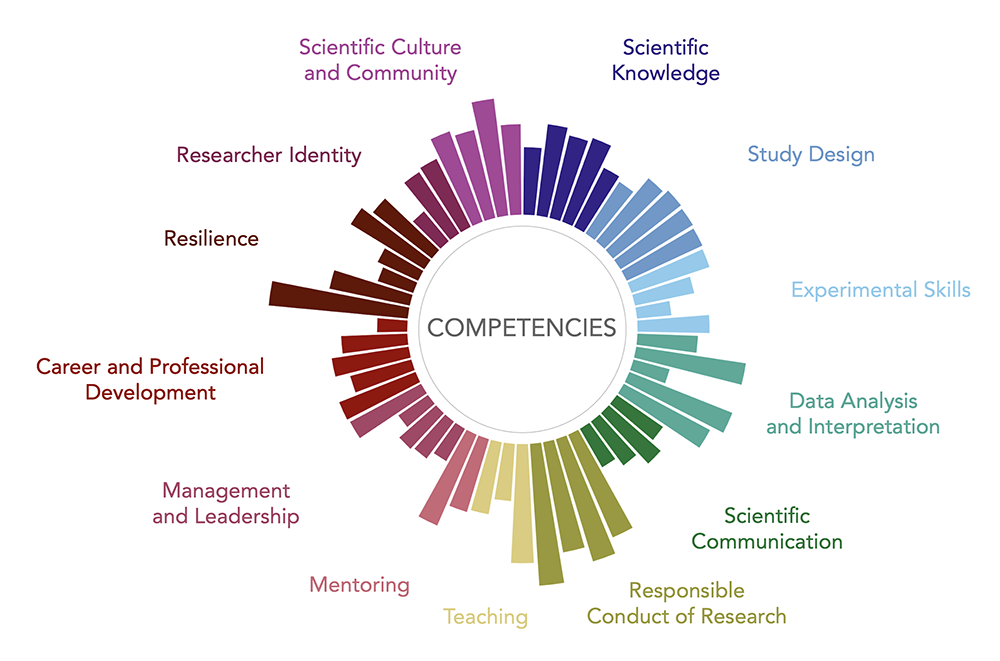
Starburst model showcasing 13 competency areas
How can this framework be used in different contexts?
Imagine a first year PhD student entering graduate school. With the competency framework, they can see their development as a broad, evolving set of skills and connect those to their own interests and long-term goals. As they advance, they can use the framework as a tool for iterative self-reflection, checking in about which areas feel strong, which need attention, and what they want to work on next.
On the other side, the mentor is looking at the same framework. It provides a shared language and reference points to talk about progress beyond simply asking “How is the project going?” Together, they can use it to set goals and identify opportunities. At the program level, that same structure helps align individual experiences with the broader training mission, making sure the curriculum and lab environments are supporting the skills we expect our trainees to develop. We used this framework to map BBS core courses and learn where the gaps are so we can adjust the curriculum as careers and expectations continue to change.
Science today is more complex, collaborative, and visible than ever. At the same time, careers for PhD scientists are more varied, and employers consistently look for strengths in communication, collaboration, project management, and responsible data handling in addition to deep technical expertise. We rely on research not only to make discoveries, but to inform public health, shape policy, and earn the trust of society.
Our competency framework is one step toward making scientific training more intentional, transparent, equitable, and holistic in how it supports trainee development. It helps trainees take ownership of their learning, helps mentors support them more effectively, and helps programs align what they say they value with what they actually teach.
No framework can capture every individual path, and we don’t see this as a rigid checklist. Instead, we see it as a flexible guide that can be adapted by different programs and institutions to fit their needs. My hope is that tools like this will help build research environments where early-career scientists are not only excellent at the bench, but also prepared to be thoughtful, responsible, and adaptable leaders in whatever careers they choose.
Jelena Patrnogić is the Director of Graduate Cancer Biology Education and Lecturer on Cell Biology at Harvard Medical School.
Learn more in the original research article:
Flexible competency framework: A tool for optimizing life science training.
Li X, Patrnogić J, Van Vactor D. PLoS Biol. 2025 Aug 27;23(8):e3003331. doi: 10.1371/journal.pbio.3003331
News Types: Community Stories