
A Shared Mechanism for Cognitive Restoration and Seizure Suppression in Neurodevelopmental Disorders
By Amar Sahay
Cognitive impairment and seizures are hallmarks of neurodevelopmental disorders and represent a large clinical unmet need. Significant advances in the genetics of neurodevelopmental disorders have identified high confidence risk genes for autism spectrum disorder or ASD (many of which define rare diseases), bipolar disorder, schizophrenia and epilepsy. Additionally, these sequencing efforts have revealed shared genetic architectures underlying these disorders. Two major challenges emerge from these findings: First, defining circuit-based instantiations of shared genetic architectures as they relate to cognition and regulation of network excitability. Second, identifying convergent circuit mechanisms that may be reinstated to improve cognitive and suppress seizures in these disorders.
Our discovery
Experience-dependent refinement of inhibitory circuits during the early postnatal period is thought to be impaired in those with neurodevelopmental disorders. Parvalbumin inhibitory neurons (PV INs) can precisely control neuronal spiking, neuronal ensembles, network oscillations and network excitability in response to experience through a process called “experience-dependent parvalbumin inhibitory neuron plasticity.” This entails the induction of cell-autonomous factors within PV INs that simultaneously coordinate the regulation of intrinsic properties, synaptic connectivity, synaptic physiology and synaptic plasticity. However, our knowledge of such factors in the hippocampus is scant.
In a screen for cell autonomous regulators experience-dependent parvalbumin inhibitory neuron plasticity (which we call “XPGs”) in the adult hippocampus (region CA3/CA2) of mice, we discovered a large suite of risk genes for ASD, bipolar disorder, schizophrenia and epilepsy as candidate XPGs. Many of these candidate XPGs encode for transcription factors and chromatin regulators whose functions in PV INs are not known. The expression of these XPGs is low, but is upregulated by experience. Understanding how XPGs concertedly control PV IN properties, physiology and plasticity will result in new insights into the formation and storage of spatial and social memories, as well as helping us better understand how the hippocampus communicates with different brain regions to calibrate many different behaviors, including social behavior.
We show in proof-of-concept studies with a commonly used mouse model of neurodevelopmental disorder risk that by selectively expressing one candidate XPG, the transcription factor Meis2, in PV INs of hippocampal subregion CA3/CA2, we can re-instate experience-dependent parvalbumin inhibitory neuron plasticity and rescue cellular, circuit, network and cognitive deficits. Additionally, this manipulation also suppressed seizures. We don’t know yet how exactly this works, but we know that MEIS2 regulates a module of genes that together define a distinct PV inhibitory neuron cell state. (If you’d like to learn more about XPGs, we invite you to explore this atlas that we created.)
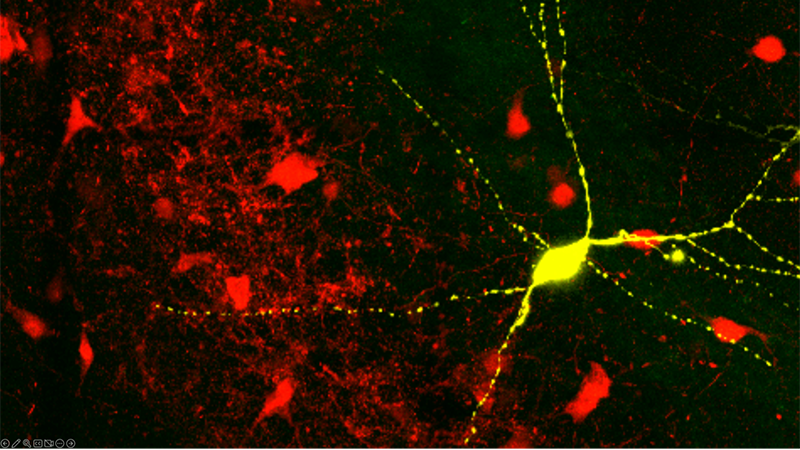
Shown in yellow is a biocytin filled parvalbumin interneuron in the hippocampus of an adult mouse (CA3/CA2 region). The red cells are other parvalbumin interneurons. Image courtesy of Jason Alipio, PhD.
Impact and Next Steps
This study builds on our prior work and suggests that PV INs transition through distinct cell states in response to experience to expand the capacity for cognitive operations. Ongoing efforts are aimed at linking PV cell states with emergent network states. Deciphering the XPG code within PV INs will inform how PV INs exert inhibition on distinct populations of pyramidal cells to create neuronal ensembles and network oscillations underlying cognition. Since PV INs contribute to circuits supporting memory, sensory processing, cognitive flexibility, decision making and attention, targeting experience-dependent PV IN plasticity may impact different domains of cognition in neurodevelopmental disorders and memory loss in aging and Alzheimer’s disease.
The development of new therapeutics for neurodevelopmental disorders is critically dependent on a deep understanding of mechanisms by which risk genes impair cognition and cause seizures. Our discovery creates a pathway for translating mechanistic knowledge into therapeutics, such as using gene therapy for individuals who harbor loss of function mutations in XPGs, many of which define rare diseases, and who exhibit seizures and intellectual disability. We hope that ongoing efforts to engage XPGs using different therapeutic modalities will ultimately enable us design, engineer and harness PV IN cell states for cognitive restoration in brain disorders. Stay tuned.
Amar Sahay is a Professor of Psychiatry at Harvard Medical School and Principal Faculty member of the Harvard Stem Cell Institute, and Massachusetts General Hospital, as well as an Associate Member of the Broad Institute.
Yu-Tzu Shih PhD and Jason Alipio PhD, postdoctoral trainees in the Sahay lab, are lead authors on this study.
Learn more in the original research article:
Procognitive restoration of PV neuron plasticity in neurodevelopmental disorders
Shih YT, Alipio JB, Klaft ZJ, Green N, Mohapatra AN, Goode TD, Panchanatham M, Pathak D, Wong LP, Sadreyev R, Hyun JH, Ahmed O, Dulla C, Sahay A. Nature. 2026 Aug 12.
News Types: Community Stories