
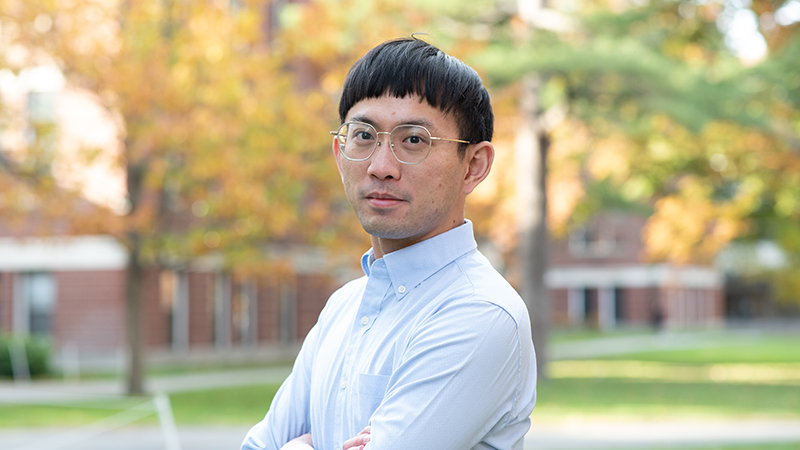
Our brain is made up of many regions that work together to handle everything from sensing the world around us to forming memories and controlling body movement. My research aims to understand how these regions coordinate their activity in awake, task-performing mice. Using an all-optical technique, I can record the brain’s electrical signals across large areas while also using light to precisely control neural activity.
Photo by Celia Muto (Mutography by Celia)
What are the big questions driving your research?
I’m fascinated by what cognitive neuroscientists called “the neuronal orchestra”. This metaphor is based on the idea that the brain’s circuitry consists of excitatory neurons, inhibitory neurons, and glial cells—each with diverse subtypes that have distinct anatomical and molecular characteristics—and these various cell types coordinate in space and time to create harmonious dynamics that underlie cognitive functions.
One fundamental question about the neuronal orchestra is how the balance between excitation and inhibition (E/I balance), known to be important for memory and cognitive performance, is maintained. I am exploring how local circuits and their interactions with distant brain regions jointly sustain E/I balance, generate neural rhythms, and support cognitive function.
What drew you to this area of neuroscience?
When I was young, I was more interested in chemistry than biology. However, my high school biology teacher changed that by showing me how beautifully organized and interconnected biology can be. Her well-structured notes on topics such as plant tissues and evolutionary trees inspired me to appreciate the complexity of biological systems and their relationships. I became particularly fascinated by the human immune system.
During my undergraduate studies in medical school, my curiosity shifted toward the brain’s immune system, which I believed must be even more intricate than what I had read in textbooks. To explore this further, I joined a lab studying the physiological and cellular mechanisms of Parkinson’s disease. Afterward, I wanted to expand my skill set and observe how the brain functions in real time—which led me to pursue in vivo functional imaging in graduate school. Through that experience, I began studying the diversity of brain cells and learning how to use advanced techniques to dissect the mechanisms underlying brain function. Over time, my focus evolved toward understanding the circuitry of the brain.
What has been the most surprising thing you’ve learned in the lab or classroom so far?
When I first learned about the sensory system in my neuroscience class, I was amazed by the many examples of sensory illusions. Take visual perception, for instance—although our eyes receive information from the external world, the images our brain produces often don’t match reality. What we see is not always what is true. Classic examples include the Hermann Grid illusion, the Müller-Lyer illusion, the Moiré effect, and the checker shadow illusion.
These phenomena reveal that our brain doesn’t simply record sensory input—it actively interprets and modifies it. While processing information from the external environment (bottom-up or outside-in), the brain simultaneously integrates internal expectations and prior knowledge (top-down or inside-out). These fascinating effects raise profound questions: How do they occur, and why does the brain rely on such mechanisms?
What are your hobbies outside of the lab—current, past, or future?
I enjoy outdoor activities and used to play volleyball on my college team. I loved the teamwork and the excitement of spiking and blocking during a match. Currently, in my free time I like reading manga and watching anime. I’m a big fan of One Piece—the passion and perseverance of its characters always inspire me to keep pushing forward. (I still remember my immunology professor once saying that he was inspired by a comic book, which eventually led to his most famous research idea.)
I also aspire to travel around the world. I want to experience diverse cultures, cuisines, and landscapes.