
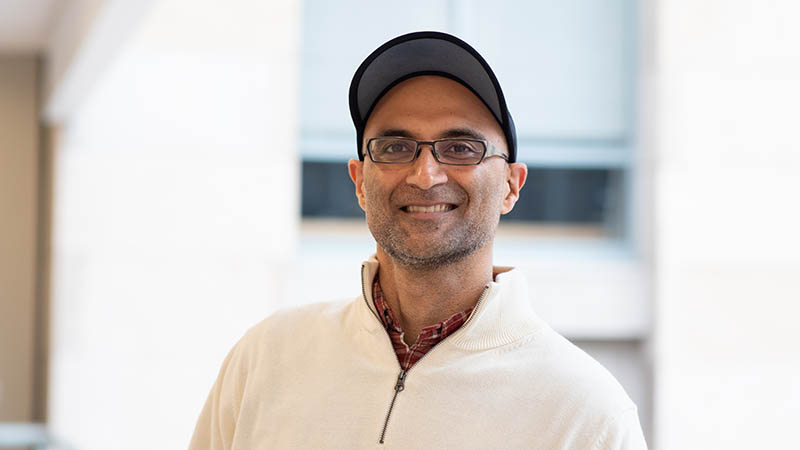
I build “virtual model organisms” with artificial bodies and artificial brains that are trained to behave like real model organisms, such as insects and fish, in simulated worlds. The activity of these artificial brains can be studied in silico to help us understand how neural systems turn sensory information into decisions and complex natural behavior. Such “digital twin” models can complement real-world experiments that are challenging, expensive, or tedious – giving us a faster entry point to begin exploring the most promising hypotheses in the lab.
Photo by Celia Muto (Mutography by Celia)
What are the big questions driving your research?
My research is driven by diverse questions spanning fundamental science, engineering, and clinical relevance. I want to understand how the brain creates adaptive behavior in the real world. Brains co-evolved with bodies, sensory systems, and the ecological niches that animals inhabit. Behavior arises from this full perception-action loop, not from neural activity alone. To study that loop in context, my research develops artificial neural networks that control virtual bodies in simulated ecologies. This approach allows us to independently vary the neural substrate, the body, the environment, and the social context to examine how each shapes behavior and neural computation.
A central challenge is making these models both useful and faithful to biology. This requires identifying which details are essential and which can be simplified. For example, in recent work modeling weakly electric fish, we found that accurately modeling the physics of electric-field generation and its interactions with prey, conspecifics, and environmental features was critical. Without that, the virtual fish learned to navigate like an entirely different type of fish. I also develop methods to “look inside” these virtual brains; for example, to understand the timescales of neural activity, to separate self-generated activity from the influence of external cues, and to quantify and compare pairs of brains.
Ultimately, I hope these models can help us reason about dysfunction. Once a digital twin reliably captures normal behavior, we can introduce targeted perturbations to investigate what breaks and why, generating testable hypotheses relevant to neurological and psychiatric disorders that could inspire new experimental and therapeutic approaches.
What drew you to this area of neuroscience?
I used to work in industry building machine-learning systems, but I felt they lacked the richness and flexibility of biological intelligence. I returned to grad school for a master’s in computer science and became increasingly inspired by AI pioneers like Richard Sutton, who treated artificial agents not just as engineering constructs but as systems whose behavior could reveal deeper principles of intelligence. I began small side projects on my own time to explore these ideas further, training artificial agents to solve increasingly complex tasks. Around this period, new research showed that artificial neural networks could learn to play video games in surprisingly human-like ways. While I had initially been interested in bringing ideas from neuroscience into AI, this shift made me realize that such techniques could also be used as scientific tools to study real brains.
I eventually switched programs and brought my ideas to my two computational neuroscientist PhD advisors and an enthusiastic experimentalist who studied flying insects. That collaboration led to my thesis work, which showed that artificial networks could spontaneously learn odor-guided navigation strategies resembling those used by real insects. In my postdoc, I’ve been building artificial neural models that capture the full closed loop of perception and action, now in environments where multiple agents interact. This lets us explore how brains may generate complex naturalistic behavior in dynamic social settings. It has become a very natural synthesis of my background in AI/ML and my interest in fundamental scientific questions.
What has been the most surprising thing you’ve learned in the lab or classroom so far?
The most surprising and fascinating realization has been how often high-performing artificial systems converge on behavioral and computational strategies remarkably similar to those found in biology, even when not explicitly programmed to do so. These patterns emerged repeatedly in the virtual organisms I designed, sometimes before I knew that similar strategies existed in biology. This suggests there may be fundamental, discoverable principles of adaptive behavior shared across brains and machines, which could be a very exciting frontier for both science and engineering. When these models fall short of explaining biology, that is equally interesting; it compels us to look for unconventional hypotheses involving an animal’s ecology or physiology to resolve the gaps.
What is the trait you most admire in others?
Intellectual generosity. Some of the most formative experiences in my career have come from people who made space for questions and helped me think through ideas with patience and care. I try my best to carry that forward with my own mentees. Given the increasing pace of modern research, this quality feels increasingly rare, and therefore all the more valuable.