
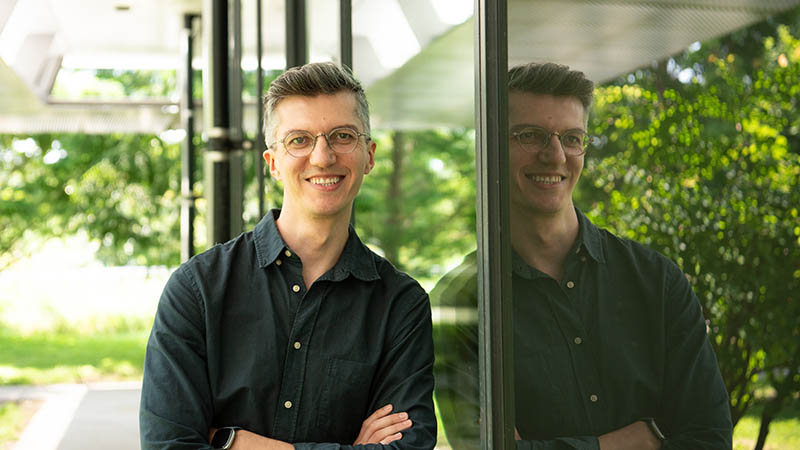
Our central nervous system has a very small capacity to regenerate. However, it has an amazing ability to rewire its circuits and adapt, whether after a traumatic injury or while we are learning a new skill. To study brain plasticity, I’m building autonomous AI systems that can help discover new patterns in complex behaviors and reveal which strategies of brain reorganization are most effective.
Photo by Celia Muto
What are the big questions driving your research?
Our brain contains about 86 billion neurons, and everything we do, feel, and think is made possible by these cells. However, it is not just the number of neurons that matters. The interactions between them—the brain’s circuitry—give rise to our capabilities.
I am primarily interested in understanding how these circuits produce complex behaviors and reorganize, as well as how they are regulated by different cell types such as microglia or astrocytes. In addition to this, I’m interested in how insights into these biological circuits can guide the design of more efficient AI architectures, and how in turn these smarter AI systems can be used to drive new scientific discoveries.
What drew you to this area of neuroscience?
I was initially drawn to neuroscience by a desire to understand how neurons regenerate after injury. However, I soon learned that the central nervous system has a very limited capacity for regeneration, which shifted my focus toward enhancing neural reorganization and plasticity as a more promising path to restoring function after CNS trauma. At the same time, I always had a strong interest in machine learning, and the parallels between biological networks and artificial neural networks naturally led me to explore how insights from one field can inform and enrich the other.
What is the first experiment you remember doing?
I clearly remember my first experiment using a combination of AAV vectors to selectively deactivate and visualize neuronal circuits involved in fine motor movements of hindlimbs in mice. Being able to precisely control a specific subset of neurons and then see them under a confocal microscope for the first time was absolutely fascinating.
What is the trait you most admire in others?
I genuinely admire people who have intellectual empathy. People who are able to consciously put themselves in someone else’s shoes to truly understand their thinking and experiences, even when their beliefs are very different. It is not about agreeing with other people or feeling sympathy, but about fairly understanding how and why someone arrives at their conclusions. This kind of open, fair-minded thinking requires setting aside personal biases and engaging with ideas that may feel uncomfortable to us. I believe that this is essential for nuanced dialogue and a clearer understanding of complex scientific and social issues.
What is an emerging area of science that you are excited about? Where you see potential for big discoveries in the next decade?
I’m really excited about the growing role of AI in scientific research. These tools are starting to reveal patterns in biology and other complex systems that we might otherwise miss, and they can help speed up processes like drug discovery or behavior analysis in neuroscience. I think the next decade will bring closer partnerships between scientists and AI, where routine tasks are handled more efficiently and researchers will (hopefully) have more time to focus on creative questions. However, I’m not blind to the potential technical and ethical challenges ahead. Designing AI systems that are reproducible, safe and transparent will be essential to the future of science.