
How One Glimpse Changes Our Neurons and What We See
By Marcelo Armendariz
Sometimes one glimpse is all it takes to change how we see the world. This ability to learn so quickly is one of the hallmarks of human intelligence. Have you ever stared at a picture that made no sense, only to have it suddenly “click” once someone showed you what was in it? A single piece of information completely changes its meaning, and from that moment on, you can’t unsee it.
Look at the classic picture below. At first glance, if you haven’t seen it before, you may see nothing but a jumble of black blobs. But if I told you that, right in the middle of the picture, there is a Dalmatian dog walking to the left, head down, sniffing the ground, the dog might suddenly pop out. And you would likely still see it days or even months later. The image hasn’t changed at all, yet you now see it completely differently. Something must have changed inside your brain.
In this study, we wanted to understand how neurons in the human brain change their activity when we rapidly learn to see something new.
Recording individual neurons in the human brain is possible only in rare clinical situations. We worked with patients with epilepsy whose seizures could not be controlled with medication. As part of their clinical care, they had thin electrodes implanted in their brains to locate where their seizures started, and they generously volunteered to take part in our research.
Participants looked at black-and-white images similar to the Dalmatian, which they could only recognize after we showed them the original photographs. Throughout the task, we recorded the activity of more than 1,000 individual neurons in the visual cortex and in memory-related regions deep in the temporal lobe, including the hippocampus. This allowed us to capture how their neuronal activity shifted as their perception changed.
Learning happened remarkably fast. Before seeing the original photographs, participants could hardly recognize any of the black-and-white images. After seeing each photograph just once or twice, they recognized most of them.
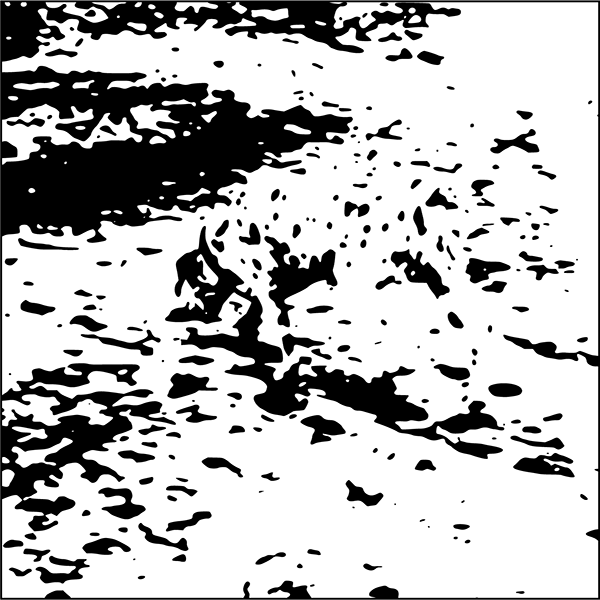
The classic Dalmatian image (Gregory, 1970). At first glance, many people see only black and white patches, but once they know that a Dalmatian dog is sniffing the ground in the middle of the picture, the dog becomes hard to miss.
Neuronal activity changed along with perception. Even though the black-and-white images were exactly the same before and after learning, neurons in both the visual cortex and the memory regions responded to them differently once participants could recognize them, and their activity came to resemble the activity triggered by the original photographs. Using machine learning methods, we tracked what information was represented in the patterns of neuronal activity, and where and when this occurred. After learning, these activity patterns carried more information about the objects in the images.
We also found that recognizing the learned images takes the brain extra time. Neurons in the visual cortex needed longer to decode the identity of the objects in the black-and-white images. Memory regions such as the hippocampus responded even later, consistent with information reaching them only after the visual cortex had resolved the images. This suggests that, after rapid learning, the brain may make sense of these difficult images through extra back-and-forth processing within the neocortex, without needing feedback from memory structures. That is notable, because many forms of rapid learning and memory formation are known to depend on the hippocampus.
Today’s artificial intelligence systems typically need thousands or even millions of examples to learn to recognize an object. Humans can do it in a single glance. Our findings bring us closer to understanding how the brain achieves this feat. Next, we aim to uncover how higher-order regions of the neocortex communicate with the visual cortex to support this remarkable ability.
Marcelo Armendariz is a Senior Scientist at Boston Children’s Hospital and Harvard Medical School.
Read more in the original research paper:
Single-neuron encoding of rapidly learned visual information reshapes human perception
Armendariz M, Blumberg J, Singer J, Aiple F, Kim J, Domínguez-Iturza N, Brandt A, Reinacher P, Schulze-Bonhage A, Kreiman G. . Nat Neurosci. 2026 Nov 4. doi: 10.1038/s41593-026-02496-6. Epub ahead of print.
News Types: Community Stories