
The Cell’s Protein Recycling Machine Has an Emergency Brake
By Urte Venclovaite
Every cell has a tiny recycling machine whose job is to find old and damaged proteins and break them down into pieces that can later be re-used. This recycling machine is called the proteasome, and its work is critical for keeping cells healthy.
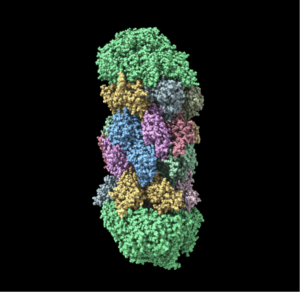
Electron microscopy structure of the 20S proteasome core particle lacking the alpha 3 subunit, in complex with PI31 (Fub1 in yeast) and Blm10.
Proteasomes play a major role in the brain, full of neurons – which are unusual cells in that they have to survive for long periods of time without being replaced when something does not work properly. For this reason, neurons depend on systems that take care of their proteins. Otherwise, damaged proteins start to accumulate in these cells and could lead to many problems – including neurodegenerative diseases like Alzheimer’s or Parkinson’s disease.
But there is a flip side to this story – an overactive proteasome could also do a lot of damage. We explored this topic in our latest study: How do cells make sure that proteasomes do not become too active? In other words, what are the brakes and levers that regulate them?
We conducted our latest study using yeast as a model system and focused on a protein called Blm10 which is essential in proteasome control but poorly understood. It has generally been considered an activator of the proteasome. Mammalian cells have a similar protein, a homologue, called PA200, also considered an activator of the proteasome.
Our discovery was quite unexpected: While Blm10 can help the proteasome carry out its duties, it can also stop the proteasome. Blm10 works in a complex with another protein called PI31, and that complex can render proteasomes inactive. Using different biochemical experiments and structural techniques, we can analyze interactions between various proteins and the proteasome. When Blm10 attaches to the outside part of the proteasome, PI31 enters the inner part of the recycling machine, where proteins are normally broken down – blocking the proteasome’s active sites and preventing it from doing its job.
Our results suggest that Blm10 and P131 work together to create a fail-safe system that keeps the cell’s protein recycling system in check. Because not every proteasome in a cell is in the same working state, cells sometimes need to temporarily pause the activity of specific proteasomes, while keeping others active. Blm10 and PI31 could act like that “emergency brake” system in the cell.
Since our experiments weren’t performed in neurons or patients having neurological diseases, we must be cautious in how we interpret them in relation to the brain. More work is needed to understand whether and how the “emergency brake” system we have described in our present study works in neurons. But we hope that understanding how protein control works in healthy cells that are easy to study in the dish will provide insights that ultimately advance our understanding of why protein control fails in neurodegenerative disease.
Urte Venclovaite is a recent graduate of the Heidelberg University Master’s Program in Molecular Biosciences (major – Neuroscience). She completed a research internship in Dr. John Hanna’s lab and conducted her thesis research in Dr. Gary Ho’s lab at Brigham and Women’s Hospital and Harvard Medical School.
Learn more in the original research article:
Blm10 and PI31 comprise a failsafe mechanism for proteasome inhibition
Fung D, Rawson S, Walsh RM Jr, Fermin Perez E, Venclovaite U, Rajakumar T, Velez B, Hanna J. Proc Natl Acad Sci U S A. 2026 Jul 28;123(30):e2611708123. doi: 10.1073/pnas.2611708123. Epub 2026 Jul 22.
News Types: Community Stories