
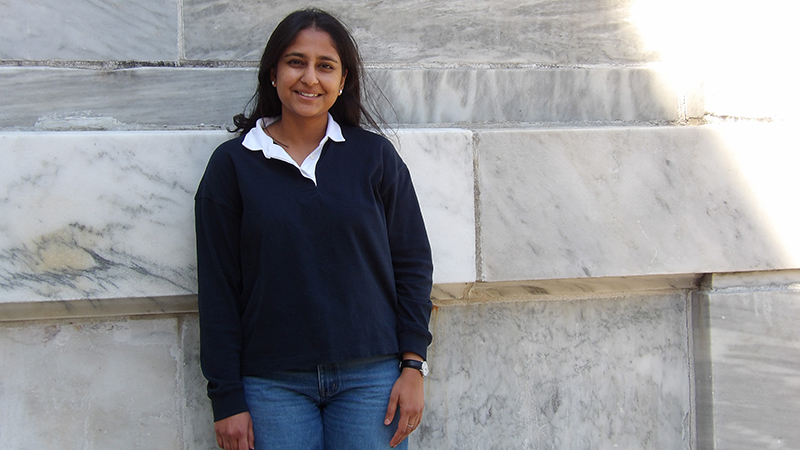
I am interested in studying the cellular computations that underlie circuit function. I study fundamental questions about how neurotransmitters work—employing a combination of cellular, physiological, and computational approaches in fruit fly models.
What is your research focused on?
The same neurotransmitter can have opposite effects on a recipient neuron, when released by two different upstream neurons. I have focused my work on the neurotransmitter glutamate, finding a neuronal population in fruit flies that is both activated and inhibited by glutamate. My research suggests that this could be because glutamate from different upstream neurons targets different ion channels. While the ion channel that mediates the inhibitory effects of glutamate in the fly brain is well understood, the ion channel that mediates the excitatory effects is not.
My thesis work aims to understand glutamate’s excitatory effects further. Work from our lab and others–including that of Wei-Chung Lee in our department– has worked to develop the complete wiring diagram of the fly brain. Further, we also know the neurotransmitters that each neuron in the fly brain releases to communicate with other neurons in the brain. Given this information and the fact that glutamate can have opposing effects on a neuron, we are working with the Lee Lab to build a computational model that can predict what effect glutamate will have on each recipient neuron. If this works, it will allow us to understand the effects neurotransmitters have on their recipient neurons and start putting signs on the wiring diagram.
What career did you aspire to as a child and why?
My answer to the question “what do you want to be when you grow up?” as a child was always “a teacher”. My grandfather was a mathematics professor and taught me math throughout school. His love for teaching was contagious. I would often find myself explaining math concepts back to him while he pretended to be the student. I have since had opportunities to teach and mentor and I have enjoyed being able to help others understand concepts that were once mysterious to me.
What has been one of the most exciting or surprising moments in your career so far?
During my undergrad, my graduate student mentor showed me a live neuron that she was recording from using a technique called patch clamp electrophysiology. I watched over as the neuron repeatedly fired action potentials. The action potentials looked like the ones I had seen in my undergrad classes and textbooks and it was so exciting to see something I had learned in my classes in a laboratory in action. I am now lucky enough to do these recordings as a graduate student myself and every time I see a neuron fire I am in awe! It does not get old.
What are some of your interests outside the lab?
I have recently started following Formula One and I have been really enjoying it. I went in not knowing much about the sport but it has been really fun trying to get up to speed with it. The sport pushes on the limits of engineering and the human capacity as drivers drive under extreme forces and temperatures.