
How Microbes Use Sex Hormones to Shape Gut-Brain Interactions
By Valentina Lagomarsino
My curiosity about microbes began with a simple question: what outside of the brain affects the brain and our behavior? Early on in my PhD training, I ventured outside of my neuroscience background to see what we could glean from microbiology on this question. I was amazed to find that the trillions of single-celled organisms that live on us and within us, collectively known as our microbiome, play a major role in regulating our mood and a range of behaviors.
I brought my excitement for microorganisms to the Rao Lab, which specializes in studying the enteric nervous system (ENS). The ENS is comprised of hundreds of millions of neurons and glia that are embedded in the gut wall. One of the main functions of the ENS is to coordinate motor circuits in the gastrointestinal (GI) tract to propel its contents from the oral cavity to excretion—a process known as GI motility. Bacteria within the gut microbiome can generate factors that signal to enteric neurons and the peripheral nervous system to influence GI motility.
Testosterone is part of a class of sex hormones called androgens that circulate at higher levels in males than females and signal through the androgen receptor. Our lab previously found that both males and females with irritable bowel syndrome have lower levels of circulating testosterone. In that same study, led by Daniella Rastelli, the team also found that male mice lacking gonadal androgens have slowed GI motility.
Our current study began as a follow up to these findings, with the goal of identifying which androgen-responsive cells in the gut are important for regulation of GI motility. I was eager also to explore a new angle: determining if bacteria in the gut microbiome alter circulating androgen levels to impact GI motility.
To answer the first question, we employed microscopy and mouse genetic tools. We identified a population of enteric inhibitory motor neurons that express NOS1 as androgen responsive, and androgenic signaling in these neurons was required for normal GI motility in male mice. We also identified a population of Nav1.8 sensory neurons, with cell bodies located outside of the colon, that express the androgen receptor and are important in the regulation of GI motility.
On the microbe arm of the project, the results were striking. We found that male mice that were administered a one-week course of broad-spectrum antibiotics had significantly reduced levels of circulating testosterone, and this was directly correlated with slowed GI motility. When we provided supplemental androgens to male mice on these broad-spectrum antibiotics, GI motility was partially rescued.
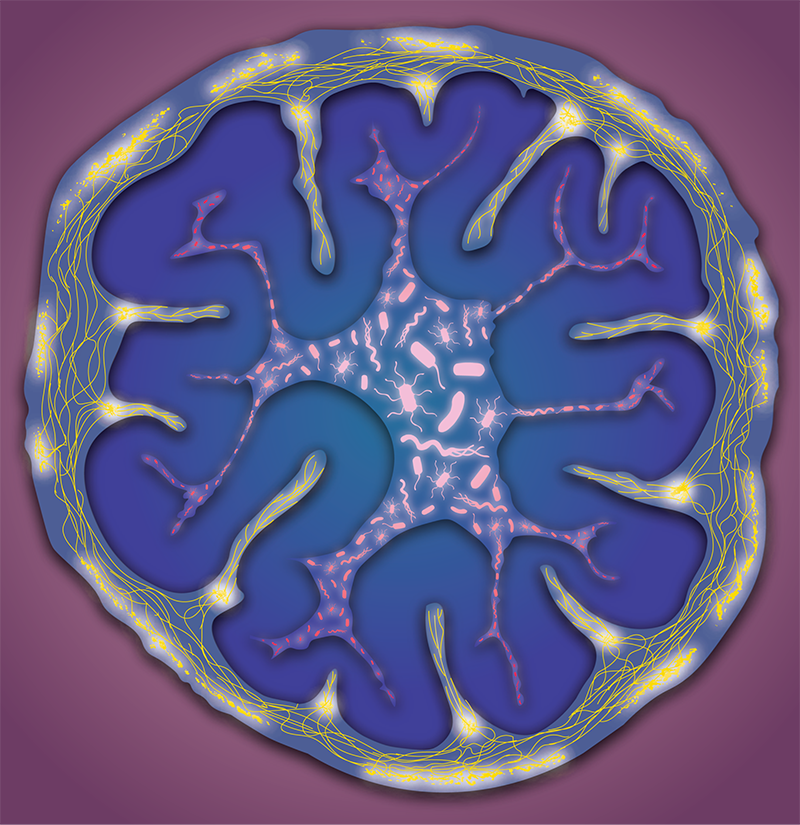
Cross section of the colon showing gut neurons in yellow and microbes in pink. Microbes live within the intestinal lumen, which is surrounded by colonic epithelium, shown in dark blue. Enteric neurons are found within the submucosa and muscularis layers surrounding the epithelium. Neuronal processes can extend to be in close proximity to the intestinal lumen—where they can receive information from microbes both directly and indirectly. Illustration created by Raphael Lagomarsino using Adobe Illustrator.
To gain a better understanding of how microbes were able to alter host androgen levels, we teamed up with many talented collaborators spanning endocrinology and microbiology. Using longitudinal stool sampling and genomic analysis, we were able to identify which microbes were present and what functional capabilities they had across age. These experiments revealed that upon puberty, following a surge in the host’s androgen levels, composition of the gut microbiome remained largely unchanged, but microbial gene prevalence shifted in way that increased the potential for microbes to metabolize host androgens. We then identified a class of microbial enzymes, β-glucuronidase (GUS) enzymes, as being able to modify androgens in vitro, and capable of restoring androgenic signaling in NOS1 enteric neurons in mice on antibiotics.
These results are exciting because they establish a novel mechanism by which microbes interact with the peripheral nervous system to regulate a neurological function vital for life. Beyond GI motility, our study reveals that the gut microbiome is a major regulator of the host androgen axis, and that this relationship is both a dynamic and bidirectional.
What’s next? There are many interesting follow ups to this study. Some of the questions we are most excited by are: How is androgenic signaling in NOS1 inhibitory neurons altering intestinal motor circuits? Do broad-spectrum antibiotics deplete circulating androgen levels in humans? Are there additional microbial GUS proteins capable of restoring androgens that could be effectively used clinically? Understanding these questions will give us a better sense of how we may be able to target this axis for the treatment of irritable bowel syndrome, and many other disorders of the gut-brain axis where altered sex hormone signaling has been implicated.
Valentina Lagomarsino is a recent graduate of the PhD Program in Biological and Biomedical Sciences at Harvard University. She conducted her doctoral work in the lab of Meenakshi Rao, in the Division of Gastroenterology, Hepatology and Nutrition within the Department of Pediatrics at Boston Children’s Hospital.
She also writes about the links between gut health and the food & agriculture system on Substack.
Learn more in the original research article:
Microbial reactivation of host androgens directs enteric neuronal regulation of gut motility
Lagomarsino VN, Robinson A, Mitchell PE, Jiang M, Hutchinson LE, Sekela JJ, Caron P, Gehris MK, Navas KI, Duarte-Silva M, Netherland M Jr, Hasan NA, Guillemette C, Redinbo MR, Rao M. Nat Neurosci. 2026 Aug;29(8):1791-1800. doi: 10.1038/s41593-026-02321-0. Epub 2026 Jun 2.
News Types: Community Stories