
Fruit Flies Can Be Guided to Interact With a Ball
By Kenichi Iwasaki
Have you ever wondered why we humans are so obsessed with a spherical object, a ball, whether it’s a soccer ball, baseball, or volleyball? We are so obsessed with moving it with our legs or throwing it with our arms that we often spend hours moving it with others or simply watching others move it around. In fact, some of the most popular sports across global cultures involve balls of different sizes and textures. Why is our nervous system so fascinated by manipulating a ball? How does the brain motivate us to interact with a ball? In a more general sense, how does our brain motivate us to interact with objects in our physical world in ways that support our survival and well-being?
To answer a mechanistic question about complex behavior, it can often be beneficial to study a smaller genetic model like fruit flies. However, fruit flies have not been used widely to study mechanisms of object manipulation because it remains a mystery whether fruit flies are capable of actively manipulating an inanimate object.
There is one major challenge we had to overcome to test whether fruit flies are capable of manipulating an object: flies do not actively seek an inanimate object that presents no obvious reward, like a pleasant odor or an attractive taste.
To solve this problem, we developed a new method to artificially guide a fly to approach an object and then interact with it so that we can study how well a fly interacts with the object. But this may sound like an impossible task to many. How do we ask a tiny insect to understand what we want it to do? We solved this seemingly impossible problem in two major steps.
First, we developed a new technique to artificially control the behavior of freely walking fruit flies so that we can make them walk toward a predetermined spatial destination with surprising precision (Figure 1).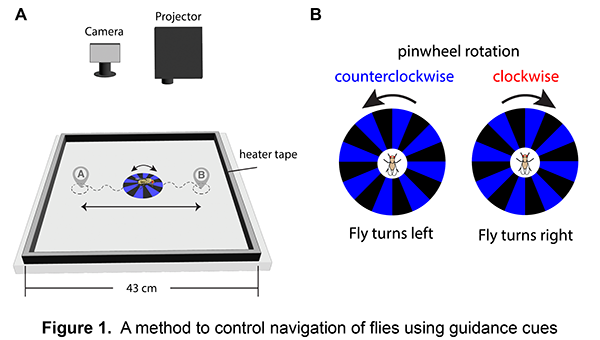
We achieved this by taking advantage of a strong behavioral response shown by fruit flies called the “optomotor response.” When a fly sees a moving visual stimulus, it finds it irresistible to follow the direction in which the stimulus is moving. We took advantage of this phenomenon to control the direction in which the fly walks by rotating a visual stimulus (“pinwheel”). This artificial guidance by a navigational cue worked surprisingly well for most flies we tested.
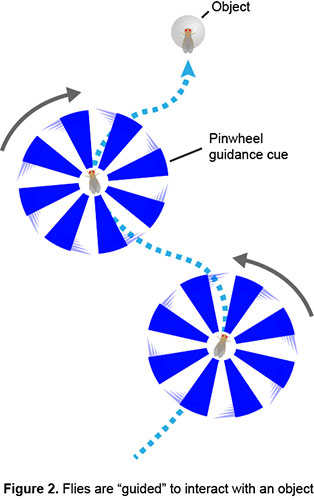
Now that we had a reliable way to make a fly walk toward a predetermined destination, we used the technique to make a fly walk toward an inanimate object repeatedly (Figure 2). The idea is that if we make a fly approach an object over and over again, it may start interacting with the object more actively in ways we have not seen before. This may sound reminiscent to some of the “exposure therapy,” in which people reduce their fear and anxiety toward an object through repeated exposure. We decided to test whether we could change how an insect behaves toward an object through repeated exposure.
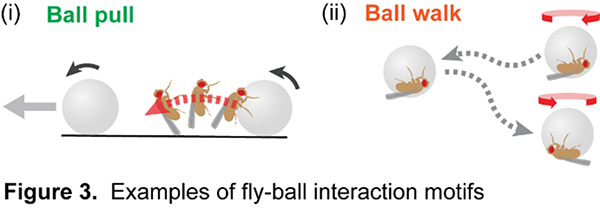
This approach led to a surprising finding. After repeated exposure to an inanimate object — a small plastic ball — flies started to grab the ball rather aggressively and manipulate it in such dexterous ways that had not been previously reported. It turns out that flies love to grab a plastic ball with their forelimbs and “throw” it using their whole body (Figure 3). They also like to hop on the ball and walk along its side to roll it around in ways that none of us could have even imagined. We decided to name this incredibly acrobatic behavior “ball walk”.
It wasn’t just the remarkable techniques flies used to move a ball around that surprised us. The flies weren’t just manipulating a ball: they were learning something important about the object while moving it around. The flies were, in fact, learning the physical properties of the ball and changing their behavior toward it.
By genetically silencing different parts of the fly brain, we found that small groups of neurons in a brain region called the “central complex” are crucial for this behavioral phenomenon.
Our studies suggest that fruit flies can be an excellent model organism for probing the mechanisms underlying object manipulation. They hold significant potential for providing new clues into how the nervous system allows organisms to interact with objects in the physical environment in ways beneficial for their survival.
Kenichi Iwasaki conducted the above studies in the laboratory of Dr. Aleksandr Rayshubskiy at the Rowland Institute at Harvard University. Dr. Iwasaki is currently a postdoctoral scholar in the lab of Dr. Benjamin de Bivort in the Department of Organismic and Evolutionary Biology at Harvard University.
Learn more in the original research articles:
The fruit fly, Drosophila melanogaster, as a microrobotics platform.
Iwasaki K, Neuhauser C, Stokes C, Rayshubskiy A. Proc Natl Acad Sci U S A. 2025 Apr 15;122(15):e2426180122. doi: 10.1073/pnas.2426180122. Epub 2025 Apr 8.
Drosophila learn to prefer immobile spherical objects through repeated physical interaction.
Iwasaki K, Kawano S, Cassod A, Neuhauser C, Rayshubskiy A. Current Biology. 2025 Nov 17;35(22):5475-5489.e4. doi: 10.1016/j.cub.2025.09.073. Epub 2025 Oct 27. Click here for video abstract.
News Types: Community Stories