
We want to understand how we learn from our mistakes. Recognizing what we did wrong is an essential part of learning – just imagine learning a new song, but without realizing you had played a wrong note. This is true not only for music, but for much of what we learn throughout our lives – from walking and talking to recognizing objects and faces. Our goal is to uncover how the brain detects errors and uses this information to guide learning.
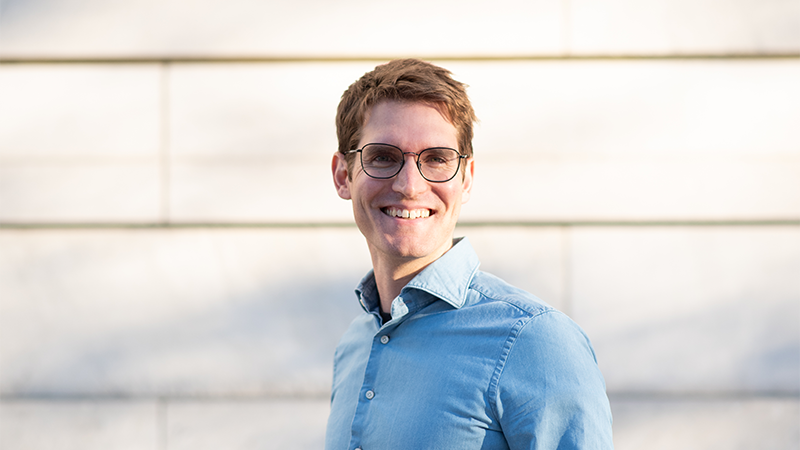
Photo by Celia Muto (Mutography by Celia).
What drew you to this area of neuroscience?
My original goal was to build tools to study cell types in the mammalian brain. That meant engineering viruses that could target specific cell types using gene regulatory elements, or enhancers. As it turned out, one of these engineered viruses—discovered by a colleague in the Greenberg lab—labeled a cell type in the cerebral cortex that I later found was signaling errors. We first saw this in the posterior parietal cortex, which is involved in decision-making, but now we’re seeing the same error-signaling role for this cell type across other cortical regions—just tuned to whatever type of error matters for each area.
To me, that’s super exciting: it suggests that error signaling might be a conserved function of this very specific cell type throughout the cortex. And it opens up a whole set of new questions: How is the error signal generated? How does it drive learning? What roles do other cell types play? And are there shared principles when we learn completely different skills? These are some of the questions we are excited to pursue in my new lab at Mass General Hospital.
What has been the most surprising thing you’ve learned in the lab or classroom so far?
I came from studying fruit flies during my PhD, where different cell types handle clearly different functions. That always felt intuitive. What I found to be really mind-bending when I moved to the mammalian cortex is that the opposite seems to be true there—all the major functions we care about, from sensory processing to cognition to motor control, are carried out by the same cell types, just acting on different kinds of information. How is that even possible?
It forced me to rethink what it means to define a cell type’s function. Instead of focusing on one cortical area at a time, we had to look for functions that cut across sensory, cognitive, and motor domains—functions that show up in multiple areas. That’s a much harder problem. But the payoff is bigger too, because whatever you find is much more likely to apply broadly. And it turns out that error signaling and learning are exactly those kinds of cross-cutting, “transcendent” functions. That’s a big part of why we’re so excited to study them going forward.
What is an emerging area of science that you are excited about? Where you see potential for big discoveries in the next decade?
The last decade was all about cataloguing neuronal cell types using tools like single-cell sequencing. I think the next decade will be about figuring out what all those cell types actually do. One thing I’m especially excited about is combining in vivo activity imaging with spatial transcriptomics — together, they can give us a totally new view of how different cell types work together. It’s kind of like the shift we had going from single-neuron recordings to population-level recordings: suddenly you see the bigger picture.
This is a key direction I want to take in my new lab, especially for questions around error signaling and learning in the cortex. But honestly, it applies to pretty much any neuroscience problem. Cell types are the basic building blocks of the brain, and I think we finally have the right tools to figure out what each of them is doing.
What are your hobbies outside of the lab—current, past, or future?
Once a year, I take a week or two to go on a canoe trip in Québec or Ontario—a tradition I’ve kept for more than fifteen years with my Canadian friends. These trips serve many purposes: they’re a chance to unwind, to disconnect completely, to reflect, and stay grounded in what is truly essential in life (no electricity, no running water, etc.). I also love the sense of adventure they bring—which I think is the same spirit that drew me to science.