
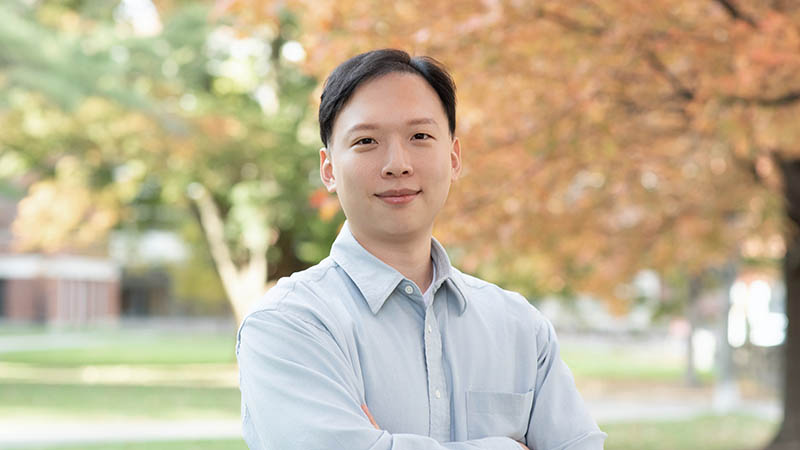
When you look at a neuron, the tiny cell body is just the tip of the iceberg. A tangle of branches called dendrites comprise a large volume of the neuron, acting like antenna for synaptic inputs. We do not fully understand how these long, thin, ion-channel-rich ‘noodles’ contribute to neural computation. I’m using optical imaging to explore this question, watching in real time the fast electrical signaling occurring in dendrites as they process information.
Photo by Celia Muto
What are the big questions driving your research?
I’m interested in understanding how neurons communicate and visualizing their activities in the brain. Specifically, what computational principles govern neuronal communication at the level of single neurons? Addressing this requires dissecting how a single neuron is organized in terms of its inputs, its outputs, and the transformations that link them.
What drew you to this area of neuroscience?
I’ve always been drawn to fundamental questions, and I’ve learned that seeing is believing. I still remember, as a first-year graduate student in South Korea, watching a video of β-actin mRNAs tagged with GFP moving along dendrites and pausing at spines. Their trajectories looked like random walks, yet they somehow reached the synapses that might be critical for memory formation. With my physics background, I was captivated and immediately wanted to model this using stochastic processes.
Over time, I realized that there is a large gap between gene expression and the neural activity that underlies memory in behaving animals. To bridge it, I combined two-photon calcium imaging with transcriptional measurements to understand what drives activity-dependent gene expression.
Now, I find myself drawn to an even more fundamental level of inquiry: how individual neurons compute their inputs. To study this, I turned to voltage imaging, which allows me to observe computation at the speed and resolution at which it occurs. In a sense, my path in neuroscience has continually moved toward finer layers of analysis — and imaging has been the light guiding that exploration.
What is an emerging area of science that you are excited about? Where you see potential for big discoveries in the next decade?
I’m excited to see how the next generation of brain-machine interfaces (BMIs) will evolve. There is still a large gap in communication between brains and computers. One approach focuses on decoding neural activity from the brain, while the other focuses on training the brain to follow machine-defined rules. I believe future BMIs won’t just read from the brain, but will also write to it, enabling true two-way communication. I’m particularly curious about how artificial intelligence could be used to leverage the understanding of biological intelligence.
What are your hobbies outside of the lab—current, past, or future?
Outside the lab, I used to do oil painting as a hobby. I think research and painting have a lot in common. When I paint, I try to rebuild what I see on the canvas. I start by really observing the subject, then I layer the paint and keep iterating. With each new layer, I adjust my approach, and often end up discovering something I didn’t expect at the beginning.